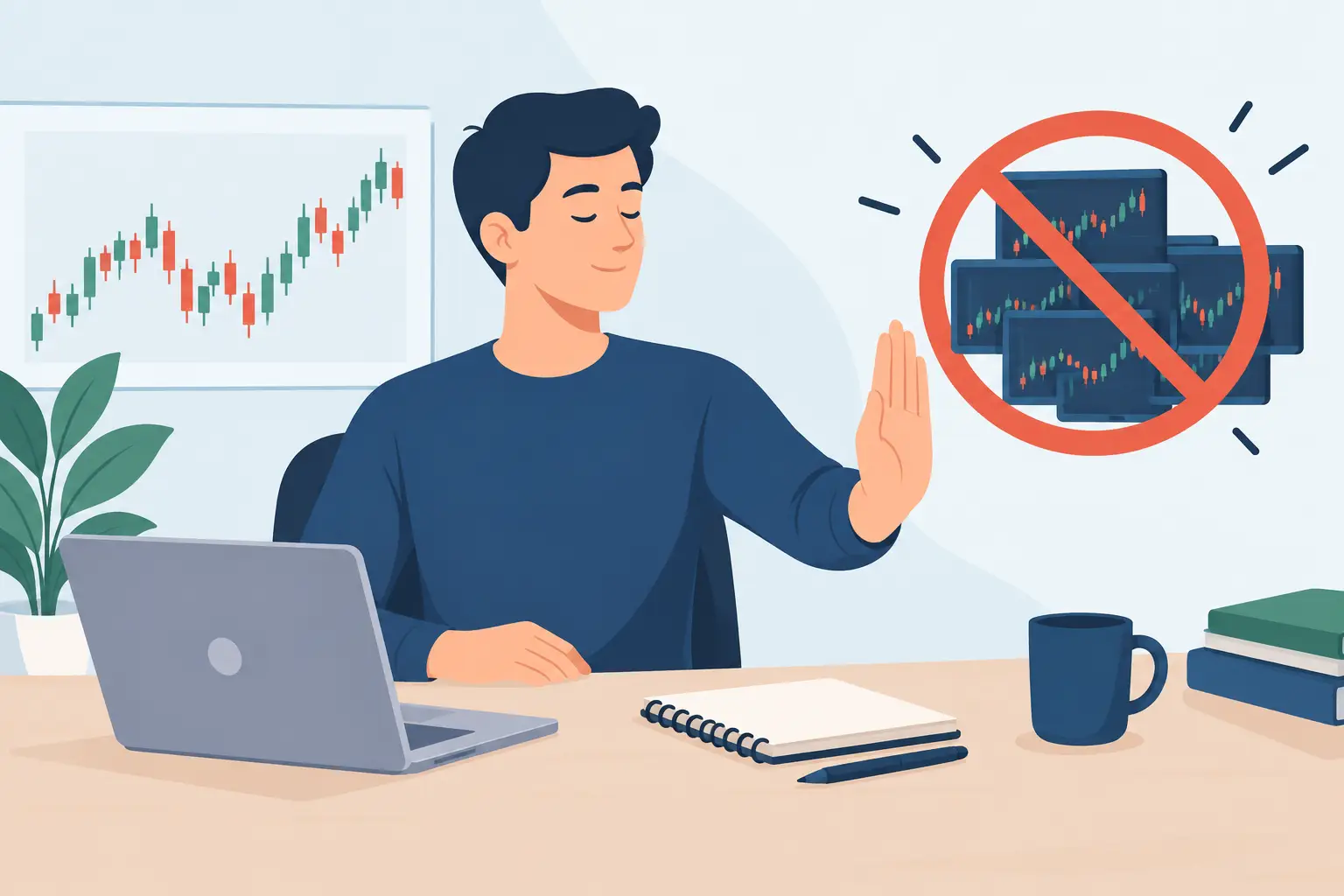
The best ways to limit overtrading start before the opening bell. By the time a trader has watched five charts, reacted to three social-media calls, and taken an unplanned entry, the problem is rarely a lack of opportunity. It is a lack of rules that decide what deserves attention.
Overtrading is not simply taking too many trades. It is taking trades that do not belong to your tested process: late entries, revenge trades, low-quality setups, oversized positions, or repeated attempts after the market has stopped offering your edge. A disciplined trader does not need to participate in every move. They need to execute well when their conditions are present.
1. Start With One Defined Premarket Plan
A broad watchlist creates optionality, but too much optionality can quickly become indecision and impulse. Before the market opens, identify the few conditions that make a stock tradable for you: a meaningful catalyst, relative volume, a clear level, sufficient liquidity, and a setup that fits your strategy.
Then narrow the plan further. Define the stock, the level that matters, the trigger for entry, the invalidation point, and the first target. If you cannot explain the trade in a few direct sentences before entering, you are likely reacting instead of executing.
This is why a focused process matters. One carefully selected premarket setup is often more useful than a screen full of possible trades. It reduces the temptation to jump between tickers every time momentum shifts.
2. Set a Daily Trade Limit Before You Trade
A trade limit is one of the most practical controls available because it creates a hard boundary around decision fatigue. The right number depends on your experience, strategy, and ability to follow rules. For some traders, that may be one planned attempt. For others, it may be two or three high-quality setups.
The key is that the limit is set before P&L influences your thinking. A trader who decides how many trades are acceptable after a loss will usually give themselves room to chase. A trader who decides after a win may give back a disciplined gain trying to force more activity.
A daily limit does not mean every allowed trade must be taken. It means you have a maximum, not a quota. If your only valid setup appears once, one trade may be the entire day.
3. Define Risk in Dollars, Not Just in Percentages
Overtrading often becomes more aggressive after losses. The trader sees red on the screen and increases size, widens a stop, or takes another entry without a clear setup. The goal changes from following a process to getting back to even.
A fixed daily loss limit interrupts that pattern. Set the maximum amount you are prepared to lose in a session, based on your account size and strategy. Also define the risk per trade. When the planned stop requires more risk than your rules allow, reduce size or pass on the trade.
For example, if a trader has a $300 daily loss limit and risks $100 per planned trade, three full losses should end the session. In practice, many traders need a tighter rule: stop after two consecutive rule-following losses, or stop immediately after one emotional or rule-breaking trade.
The exact threshold depends on the system. The purpose is constant: protect capital and protect decision quality when conditions are no longer favorable.
4. Trade Only at Predefined Locations
A setup can be valid while a specific entry is not. This distinction is where many traders lose control. They identify a stock with volume and a catalyst, then chase it after it extends far beyond the planned entry area.
Define where a trade is allowed. That may be a reclaim of VWAP, a break and hold above premarket high, a pullback into a key support level, or a failed breakout that meets your short criteria. The pattern itself matters less than your ability to recognize, test, and repeat it.
If price runs without giving the planned entry, let it go. Missing a move is not the same as making a mistake. Chasing because a stock is moving is a different decision than entering because your setup triggered.
5. Use a Cooldown Rule After Every Exit
Fast exits can create fast re-entries. After taking a loss, traders often reopen the same position because they still believe the idea is correct. After taking a profit, they may re-enter because they fear missing the next leg. Both situations can lead to lower-quality trades.
A short mandatory pause creates separation between the completed trade and the next decision. It can be five minutes, one completed candle on your trading timeframe, or a requirement that price forms an entirely new setup.
During that pause, ask three direct questions: Did the original thesis fail? Is there a new valid entry signal? Is this trade within my daily risk and trade limits? If the answer is not clear, there is no reason to act.
6. Separate Market Information From Trade Signals
Premarket trading produces a large volume of information: news headlines, gap percentages, float data, volume changes, scanner results, and commentary from other traders. Useful information can become harmful when it is treated as an automatic reason to enter.
A catalyst may explain why a stock is active, but it does not guarantee a directional move. High relative volume may create opportunity, but it can also produce volatility that does not fit your risk parameters. VWAP can be an important reference, but price touching VWAP is not a complete setup by itself.
Create a written distinction between what puts a stock on your radar and what authorizes a trade. The first category is observation. The second is execution. Keeping those separate prevents every new data point from becoming a reason to click buy or sell.
7. Keep a Rule-Based Trading Journal
A journal should do more than record entry and exit prices. It should reveal whether your trading volume is connected to your edge or to your emotions.
After each session, document the setup, catalyst, entry reason, stop location, exit reason, size, and whether the trade followed your rules. Tag trades that were impulsive, late, oversized, or taken outside your normal time window. Over a few weeks, patterns become difficult to ignore.
You may find that your best trades occur during a narrow morning window, while most avoidable losses happen after your first planned trade. Or you may find that you trade responsibly on green days but become highly active after an early stop-out. Those observations are more useful than vague promises to be more disciplined tomorrow.
Transparency is useful here. A complete record should include targets reached, stopped trades, time-outs, and mistakes. Reviewing only the winners teaches very little about why overtrading happens.
8. Build a Shutdown Routine
The session needs a defined end, especially for traders who work a job, trade the premarket, or struggle with the urge to make back losses. Your shutdown rule can be time-based, performance-based, or both.
A time-based rule might be ending participation after the first 60 or 90 minutes of the regular session. A performance-based rule might be stopping after reaching a planned profit target, a daily loss limit, or a set number of trades. The best rule is one you can follow consistently without renegotiating it in real time.
Close unnecessary charts, turn off scanners, and write the final journal note. Leaving the platform open after your plan is complete invites a new round of unplanned decisions.
Why Limiting Trades Can Improve Execution
Taking fewer trades does not automatically make a trader profitable. A poor setup taken once is still a poor setup. But reducing unnecessary trades gives each decision more room for analysis, proper sizing, and clean risk management.
It also makes performance easier to evaluate. When you take ten loosely related trades in a morning, it is hard to know what worked. When you take one or two setups that meet the same criteria, you can compare outcomes, refine the process, and identify whether the edge is real.
The market will offer more movement tomorrow. Your job is not to capture all of it. Prepare before the open, wait for your conditions, and let a disciplined stop be part of a successful trading day.