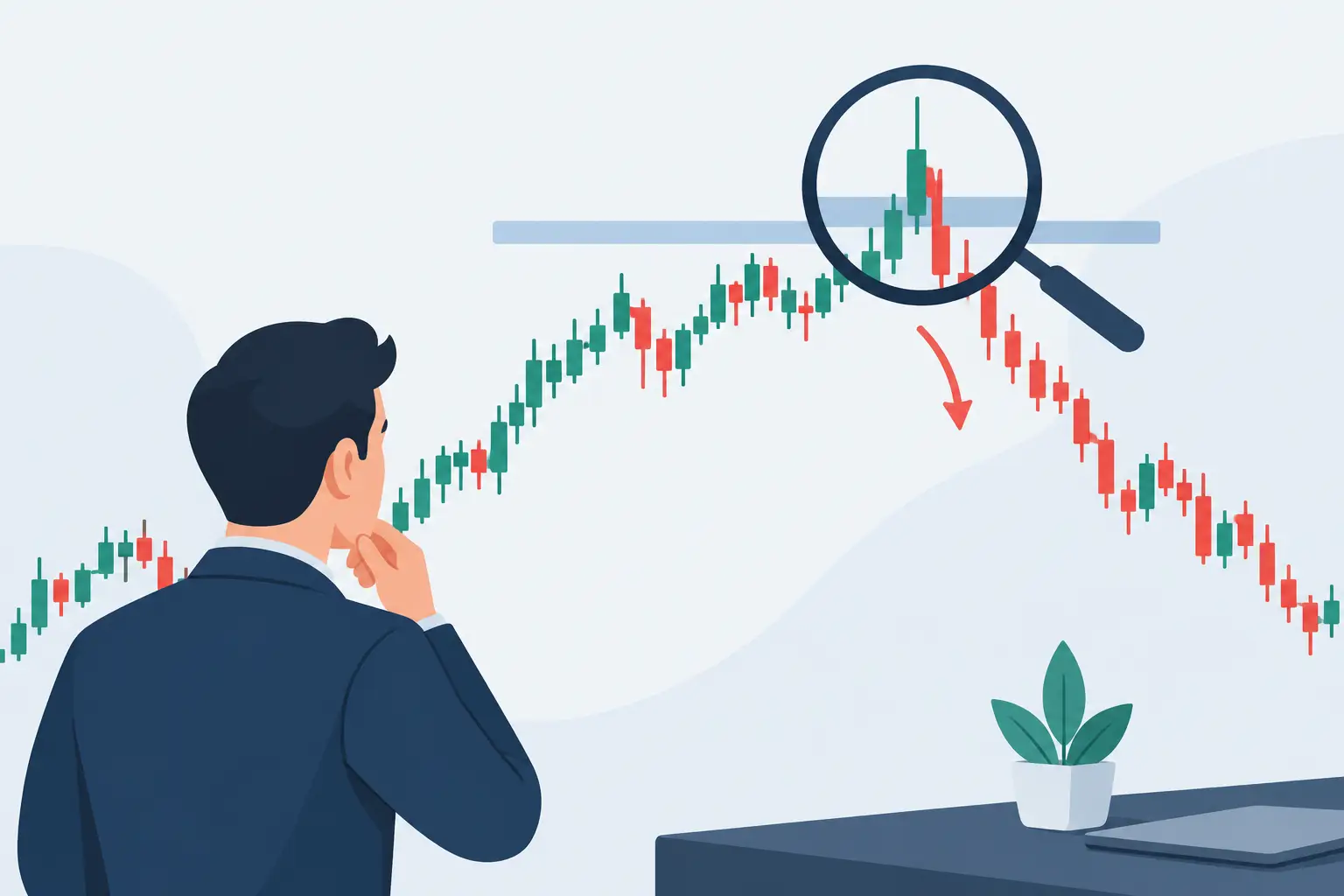
A stock pushes through a clear premarket high, the tape accelerates, and traders pile in. Two minutes later, it slips back below the level, volume fades, and the breakout buyers are trapped. Learning how to spot false breakouts is not about predicting every failed move. It is about requiring enough evidence before you commit risk.
False breakouts are especially costly in premarket trading because liquidity is thinner, spreads can be wider, and a small number of aggressive orders can move price through an obvious level. The answer is not to avoid every breakout. The answer is to define what a valid breakout must show, then step aside when those conditions are missing.
What Makes a Breakout False?
A breakout occurs when price moves through a meaningful resistance level, such as the premarket high, a prior-day high, or a well-defined range high. It becomes false when price cannot hold above that level and quickly returns back into the prior range.
The key word is hold. A single print above resistance is not confirmation. In thin premarket conditions, a stock can trade a few cents or even a dollar above a level without building real acceptance there. Traders who treat the first push as proof often enter at the point of maximum uncertainty.
A false breakout does not mean the stock is weak for the entire session. It means the initial attempt failed. It may reclaim the level later with better volume and structure. Your job is to trade the setup in front of you, not the move you hoped would develop.
Start With a Level That Actually Matters
You cannot identify a false breakout if the breakout level is arbitrary. Before the opening bell, mark levels that other traders are likely watching: the premarket high and low, prior-day high and low, major whole-dollar prices, and areas where price repeatedly reversed.
The strongest levels usually have context. A premarket high formed on heavy volume after a news catalyst carries more weight than a random high created by a few low-volume prints at 5:30 AM. Likewise, a prior-day high matters more when the stock closed near it and returns to test it with active participation.
Keep the chart simple. Too many lines create too many reasons to act. A focused trader should be able to name the level, explain why it matters, and define what would invalidate the trade before entering.
How to Spot False Breakouts With Volume
Volume is not a standalone signal, but it is one of the clearest ways to judge whether a breakout has participation. A valid move through resistance generally needs expanding volume at the moment price clears the level. If price rises while volume contracts, the move may be running on limited liquidity rather than broad demand.
Watch what happens immediately after the break. Does volume remain elevated while price builds above the level? Or does the initial surge produce one large candle followed by small, weak candles that cannot extend? The second pattern often signals exhaustion.
Premarket volume requires perspective. A stock trading 20,000 shares per minute may be highly active for one ticker and nearly inactive for another. Compare current activity with the stock's normal behavior, its recent sessions, and the volume that built the level being tested.
A useful question is: who is still buying after the breakout? If there is no follow-through, late buyers may be the only participants supporting price. That is a poor foundation for a long entry.
Read the Reclaim and Failure Around VWAP
VWAP can provide a practical reference point once enough trading has occurred. When a stock breaks above a key level and stays above VWAP, the setup may have better structure. When it breaks out but immediately loses VWAP, it suggests buyers are losing control of the intraday auction.
This is not a rule that applies identically to every premarket chart. Early in the session, VWAP may be less useful if volume is sparse or distorted by one outsized block. But when the stock has traded enough volume, VWAP can help separate an orderly hold from a fast rejection.
For a long breakout, a common warning sequence is clear: price pushes above resistance, stalls, breaks back below the level, then loses VWAP on increasing volume. At that point, the original long thesis has changed. Holding and hoping is not trade management.
The opposite is also true. A brief dip under a breakout level is not automatically failure if price quickly reclaims it, holds above VWAP, and attracts renewed volume. This is why traders should avoid treating every red candle as a reason to panic. Structure matters more than one candle.
Check the Catalyst Before You Trust the Chart
A chart can show a clean premarket breakout, but the catalyst determines whether the move has a reason to attract sustained attention. Earnings, FDA decisions, major contracts, guidance changes, mergers, and material company news can create the interest needed for continuation. A vague headline, recycled story, or social-media rumor often cannot.
The catalyst does not guarantee follow-through. Even high-quality news can produce a sell-the-news reaction. It does, however, help you assess whether the volume and price action are likely to have a broader base of participants.
Be particularly cautious when a stock is up sharply without a clear reason. Those moves can still trade, but they often require tighter risk and faster decision-making. When the only thesis is that price is moving, you are more exposed to a sudden liquidity reversal.
Wait for Confirmation Instead of Buying the First Tick
The simplest way to reduce false-breakout entries is to stop buying the first tick through resistance. Let the level prove itself.
Confirmation can take different forms depending on the stock and your timeframe. It may be a one-minute candle that closes above the level with strong volume. It may be a breakout, a controlled pullback that holds the former resistance as support, and a push to a new high. In faster names, it may be a clean reclaim after an initial rejection.
Waiting has a trade-off: you may miss some of the fastest moves and receive a less favorable entry price. That is acceptable. A process is not designed to catch every move. It is designed to improve the quality of the opportunities you choose to take.
For traders with limited morning time, this is especially useful. One well-defined setup with a confirmed trigger is more actionable than chasing five charts that are all approaching resistance.
Define the Stop Before the Breakout Happens
A false breakout becomes expensive when the stop is undefined. Before entry, identify the price action that proves you are wrong. For some setups, that may be a break back below the breakout level. For others, it may be a loss of the most recent higher low or VWAP.
The stop should fit the stock's volatility. A tight stop on a highly volatile small-cap ticker may get hit by normal movement. A wide stop on a liquid large-cap may create more risk than the setup justifies. Position size should adjust to the stop distance, not the other way around.
Avoid moving the stop lower simply because price failed. If the trade required a hold above resistance and price loses that level, the original premise is gone. Exiting a failed setup is not an admission that the market beat you. It is execution.
A Premarket Checklist for Breakout Quality
Before taking a breakout trade, run a short, repeatable check:
- Is there a clear catalyst and enough relative volume?
- Is the resistance level obvious and meaningful?
- Did price break with expanding volume, not just a thin spike?
- Is price holding above the level and behaving constructively around VWAP?
- Is the entry, stop, and invalidation point defined before the order is placed?
If several answers are unclear, there is no requirement to trade. The market will offer another setup. Selectivity is often the difference between active trading and impulsive trading.
Use Failed Breakouts as Information
A failed breakout can also reveal useful information about the other side of the market. When buyers cannot hold a widely watched high, trapped longs may sell on the next bounce. That can create pressure back toward VWAP, the premarket midpoint, or lower support levels.
That does not mean every failed breakout becomes a short. Shorting carries its own risks, particularly in news-driven stocks that can reclaim levels quickly. It means the failure should update your view. Do not stay anchored to the bullish story after the structure has turned against it.
At Seven01, the focus is one defined premarket opportunity rather than constant alerts across a crowded watchlist. That approach supports better breakout decisions because it leaves room to study the catalyst, mark the levels, and wait for confirmation instead of reacting to every price spike.
The next time a stock trades through a major premarket high, resist the urge to label it a breakout immediately. Watch whether price can hold, whether volume stays present, and whether your planned risk still makes sense. Patience at the level is often what keeps a promising chart from becoming an avoidable loss.