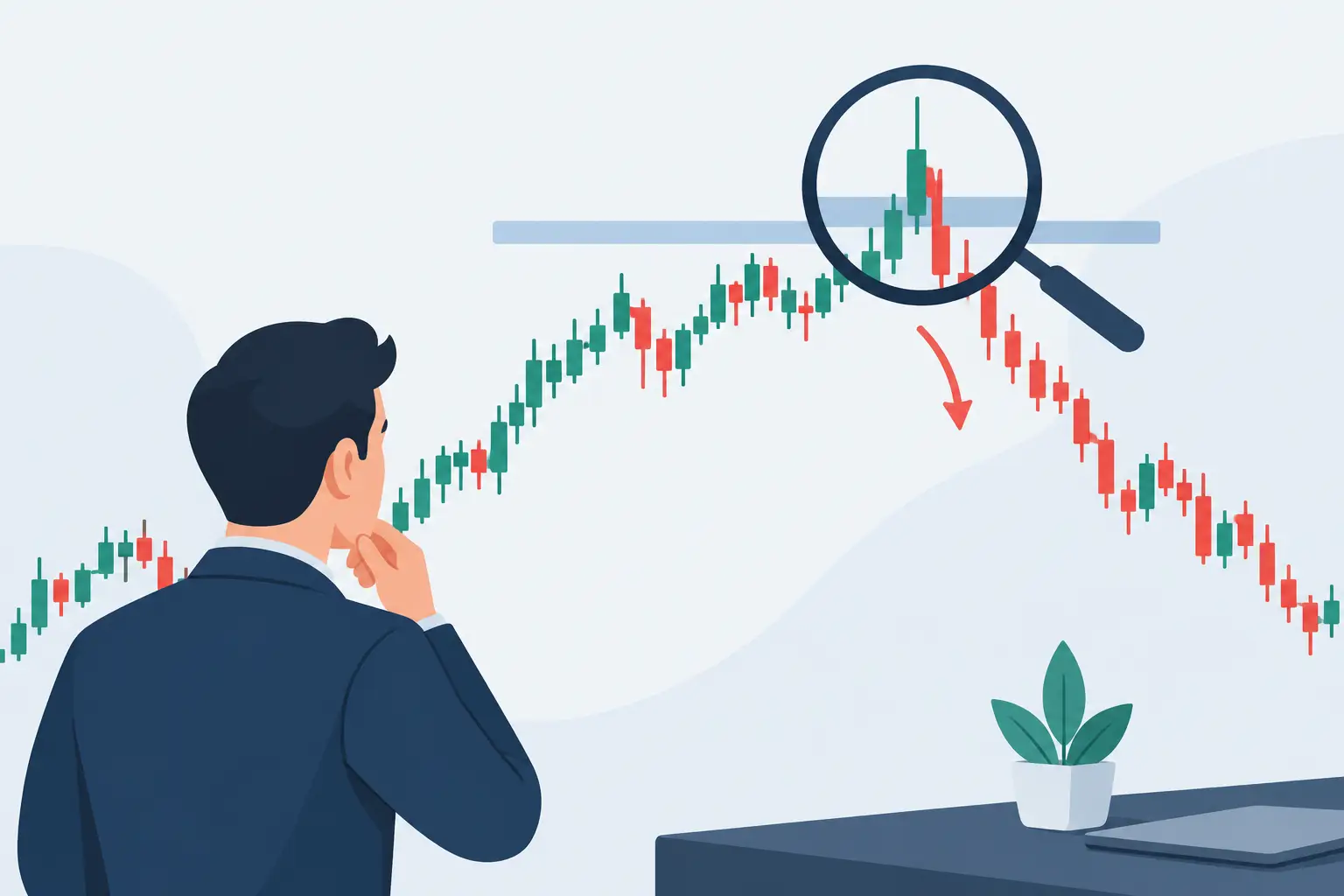
A premarket chart can move 10% before most traders finish their first coffee. That speed is exactly why a morning risk management guide matters: your risk decisions need to be made before a fast-moving stock asks you to make them under pressure.
Premarket trading can offer clean opportunities around earnings, FDA decisions, guidance changes, mergers, major news, and unusual volume. It can also produce thin order books, wide spreads, sudden reversals, and fills that differ materially from the price on your screen. The goal is not to eliminate those conditions. The goal is to participate only when the potential reward, liquidity, and invalidation level justify the risk.
A disciplined morning begins with one question: if this setup fails, what is the maximum amount I am prepared to lose? Everything else - position size, entry timing, stop placement, and whether to trade at all - follows from that answer.
Set Your Daily Risk Before You Scan
Do not let the stock determine how much you risk. Set a daily loss limit before you open a scanner or look at social media. This is the maximum amount you can lose across all trades for the session before you stop placing new trades.
The number should be meaningful enough to protect your account and your decision-making. It should also fit your experience, trading frequency, and financial situation. A newer trader may use a smaller fixed dollar amount while building consistency. A more experienced trader may use a percentage-based limit. Neither approach makes sense if it changes after a loss because you want to get even.
Your daily limit is different from risk per trade. If your daily maximum loss is $300, you might risk $100 on a single setup. That gives you room for several valid attempts without allowing a rough morning to become an account-level problem. Some traders choose to stop after two full losses even if a small portion of the daily limit remains. That can be useful when the losses signal that the market conditions or your execution are out of sync.
Write down the rule in plain language: “After my daily loss limit is reached, I am done for the day.” A rule that requires interpretation at 9:45 AM is not a rule. It is a suggestion.
Define the Trade Before the Entry
A valid premarket plan has four parts: a catalyst, a level, an invalidation point, and an exit framework. The catalyst explains why the stock is active. The level identifies where participation makes sense. The invalidation point defines where the setup is no longer working. The exit framework establishes how you will respond if price moves in your favor.
For example, a stock may gap higher after earnings and consolidate above a premarket support area on sustained volume. A trader may plan an entry only if that support holds and buyers reclaim a nearby intraday level. The stop belongs below the point that proves the thesis wrong, not at a random dollar amount that happens to feel comfortable.
This distinction matters. A stop that is too tight relative to normal price movement can turn a sound idea into a series of avoidable losses. A stop that is too wide forces smaller size and may indicate that the entry is poorly defined. If you cannot identify a logical invalidation level, you do not yet have a defined trade.
Premarket stops require additional caution. Lower liquidity can create gaps through a stop price, particularly in small-cap names or stocks reacting to headline risk. A stop order may help limit loss, but it does not guarantee the exact execution price. Build that possibility into your expectations rather than assuming every exit will be clean.
Calculate Position Size From the Stop
Position size is the practical link between a trade idea and account protection. Start with the dollar amount you are willing to risk, then divide it by the distance between your entry and stop.
If you are willing to risk $100 and your entry is $10.20 with a stop at $9.95, your per-share risk is $0.25. The position size is 400 shares, because 400 multiplied by $0.25 equals $100. If the spread is wide or the stock is moving unusually fast, reducing that size creates room for slippage.
The formula is simple:
`Position size = maximum dollar risk / risk per share`
The calculation becomes less precise when fills are uncertain. That is not a reason to ignore it. It is a reason to use a buffer. If a thin premarket stock can reasonably slip several cents beyond your stop, calculate size against a wider effective risk amount or pass on the trade.
Avoid increasing share size just because a stock “looks obvious.” The market does not reward conviction by reducing risk. Large size magnifies every execution mistake, every hesitation, and every unexpected headline.
Use Liquidity as a Risk Filter
A chart can look clean and still be untradeable at your intended size. Before entering, assess average volume, current relative volume, bid-ask spread, depth of market, and how price responds when orders hit the tape.
A stock trading with a one-cent spread and consistent transactions is structurally different from a stock showing a 20-cent spread with sporadic prints. In the second case, the displayed last price may not be a realistic exit price. Your position may also become difficult to reduce without moving the market against yourself.
Liquidity requirements should be personal. A trader using 25 shares has different constraints from a trader using 2,500 shares. Test your assumptions with small size and review actual entry and exit fills. The fill quality in your journal is more useful than a chart replay that assumes perfect execution.
A simple rule helps: if the spread or order-book behavior makes your planned stop unrealistic, do not take the trade. Missing a move costs nothing. Holding an oversized position in a thin name can cost far more than the original plan allowed.
Control Risk at the Open
The transition from premarket to the 9:30 AM ET open changes the character of many stocks. Volume often expands sharply. Spreads can tighten, but volatility can increase as institutional orders, overnight participants, and opening-auction activity enter the market.
Decide before the open whether your premarket position is meant to be held through that transition. There is no universal answer. A position with strong volume, a clear catalyst, and room to a defined target may justify holding partial size. A stock that is extended, illiquid, or failing to hold a key level may not.
Do not let the opening bell make the decision for you. If holding through the open is part of the plan, specify what confirms the hold and what requires an immediate exit. If it is not part of the plan, reduce or close the position before the transition. Both choices are valid when made deliberately.
This is also where partial exits can be useful. Taking a portion of the position off near a planned target reduces exposure while leaving a smaller amount for a continued move. But partialing out should not become an excuse to avoid a full stop. A losing trade still needs a clear exit point.
Prevent the Most Expensive Morning Mistakes
The largest losses often start as small process failures. The trader enters before checking the catalyst. The stop is moved lower because the stock “should bounce.” A second trade is taken immediately after a loss, not because a new setup appeared, but because frustration did.
Use a brief pre-entry check:
- Is there a verified catalyst and meaningful volume?
- Is my entry level specific, rather than reactive?
- Where is the setup invalidated?
- What is my actual dollar risk after allowing for spread and slippage?
- Does this trade fit within my daily loss limit?
If you cannot answer each question quickly, wait. Speed without clarity is not an edge.
A time stop can also protect against dead money and drifting attention. If a setup was expected to resolve within a defined period but volume disappears and price stalls, closing or reducing may be appropriate even if the hard stop has not been reached. Time stops depend on the setup. A breakout trade and a longer intraday trend trade should not be managed the same way.
Review Execution, Not Just P&L
A green trade can be poorly managed. A red trade can be executed exactly as planned. If you review only profit and loss, you will reinforce outcomes rather than process.
After the session, record the catalyst, entry, stop, size, exits, maximum favorable movement, maximum adverse movement, and whether you followed the plan. Note the market condition as well. A clean gap-and-go morning behaves differently from a broad risk-off session with failed breakouts.
Over time, this record shows where your risk actually comes from. You may find that your largest losses occur in low-float names, during the first five minutes after the open, or after you take a second setup outside your plan. Those are actionable findings. “I need to trade better” is not.
Seven01 is built around the same discipline: one selected setup, defined levels, and transparent documentation of targets, stops, and time-outs. A focused process does not guarantee an outcome. It gives you a standard for deciding whether the next trade deserves risk.
Tomorrow morning, do not start by asking which stock will move the most. Start by defining what you can lose, what would prove the idea wrong, and what conditions make the trade worth taking. That is how a premarket routine becomes sustainable.